Venturi Tube Applications: Common Uses by Industry
Accurate flow data keeps pipelines safe, plants efficient, and operators compliant, which is why venturi tube applications reach well beyond a single industry. The same narrowing-and-widening geometry that lets a Venturi tube measure flow in an oil and gas line also powers scrubbers that clean exhaust gas, masks that deliver a set oxygen concentration, and injectors that feed fertilizer into irrigation water.
A Venturi tube is a section of pipe with a converging inlet, a narrow throat, and a diverging outlet. As the fluid speeds up in the throat its static pressure drops, and that pressure difference reveals the flow rate, which makes it a classic differential pressure flow measurement device. The sections below cover where it is used and what makes it the right tool in each setting.
Venturi Tube Applications at a Glance
| Industry | What the Venturi does | Why it fits |
|---|---|---|
| Oil and gas | Measures liquid and gas flow in pipelines and process lines | Accurate differential pressure measurement with low permanent pressure loss |
| Water and wastewater | Measures flow in treatment, delivery, and process piping | High accuracy with comparatively small head loss |
| Irrigation and agriculture | Measures farm turnout flow and field runoff; draws fertilizer into irrigation lines | Low cost options and no moving parts |
| Chemical processing | Monitors and controls reactant and product flow | Materials can be chosen to suit the fluid |
| Power generation | Measures steam, feedwater, and cooling water flow | Low permanent pressure loss protects pumping energy |
| Air pollution control | Venturi scrubbers capture fine particulate from exhaust gas | Throat acceleration atomizes scrubbing liquid |
| Medical | Venturi masks deliver a set oxygen concentration | Jet entrainment of room air gives a fixed mixture |
| Automotive and HVAC | Carburetors draw fuel into airflow; Venturi air valves control airflow | The pressure drop in the throat does the work |
What Makes a Venturi Tube So Widely Used?
The U.S. Bureau of Reclamation describes Venturi meters as one of the oldest and most reliable differential head meters. It notes that true Venturi meters have no stagnant zones, are more tolerant of upstream conditions, have lower head loss, avoid fouling problems, and are more accurate than most other meters. Commercially produced units claim a primary device accuracy of plus or minus 0.5 percent, and the discharge coefficient for standard Venturi meters is typically between 0.96 and 0.99.
For pipe measurement the geometry is standardized. ISO 5167-4:2022 specifies Venturi tubes for conduits running full and applies where the flow stays subsonic and the fluid is single-phase. It does not cover pulsating flow.
Venturi Tube Applications in Oil and Gas
Pipeline and Process Flow Measurement
In oil and gas, accurate volumes of oil, gas, and water flowing through a line support allocation, operational efficiency, and regulatory reporting. Venturi tubes suit this work because the diverging cone recovers most of the pressure, so the meter adds little permanent loss to the line, and because the open, smooth throat has no small ports to plug. They are used in gathering lines, process piping, and transmission service.
A Venturi reads best when the flow profile is settled before the inlet, and straightening vanes are one way to condition the stream where space for straight pipe is limited.
Multiphase Flow Metering
Oil and gas production often moves mixtures of gas, oil, and water. Differential pressure from a Venturi can be combined with other sensors and calculations to estimate the flow of each phase, which helps operators track well performance. Because this application depends on the specific instrument package, the Venturi is one component of a larger metering system rather than a standalone answer.
Water and Wastewater Uses for Venturi Tubes
Municipal Water and Treatment Plants
Water utilities and treatment plants need to know how much water, treated effluent, and chemical solution moves through each pipe. Because a Venturi has no moving parts and recovers pressure, it is a durable fit for long-term service in these lines. Complete Venturi flow meter systems pair the Venturi with a differential pressure transmitter so the readings can feed plant controls.
Venturi Tube Applications in Irrigation and Agriculture
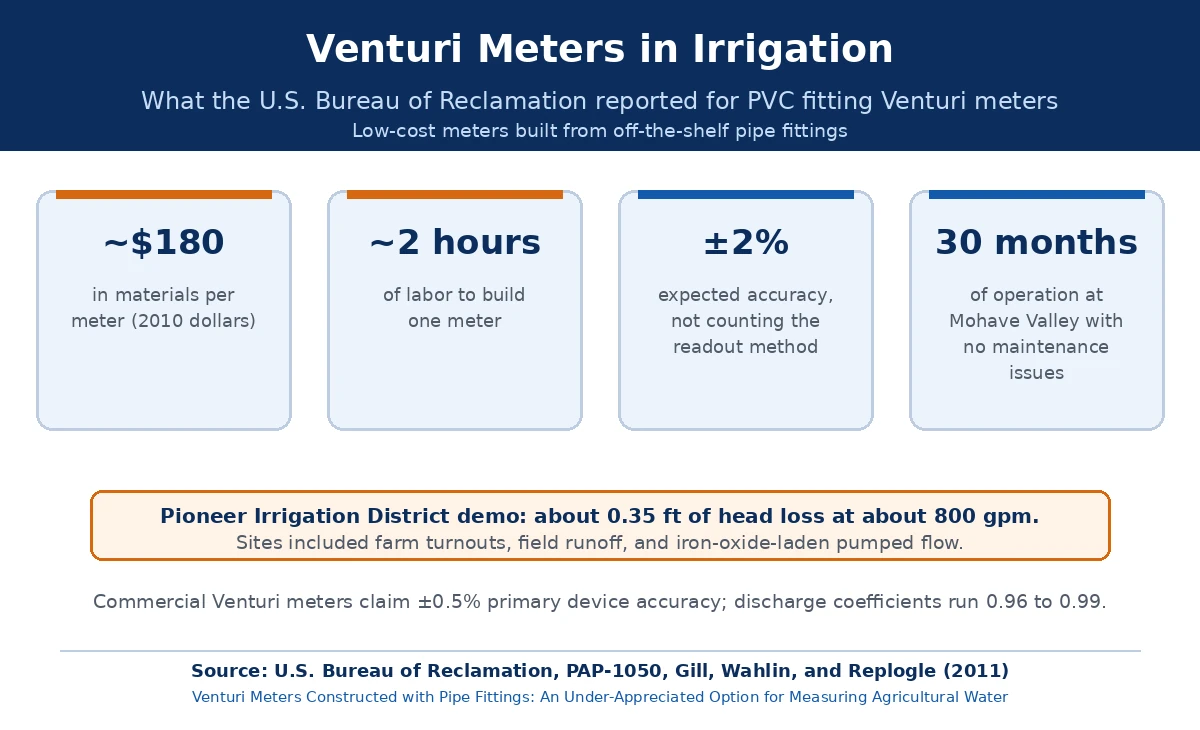
Agriculture shows how flexible the design can be. The Bureau of Reclamation documents Venturi meters built from off-the-shelf PVC fittings at about $180 in materials and roughly two hours of labor, with an expected accuracy of about plus or minus 2 percent. They were installed at farm turnouts, on field runoff culverts, and on a pumped line carrying high concentrations of iron oxide, where a Venturi at Mohave Valley ran for about 30 months without maintenance issues. The paper also reports about 0.35 feet of head loss at roughly 800 gallons per minute at the Pioneer Irrigation District demonstration.
A related farm use is the Venturi injector, which uses the pressure drop in a throat to draw liquid fertilizer into an irrigation line. That is an injection job rather than a metering job, but it relies on the same pressure behavior.
Chemical, Power, and Industrial Processing Uses
Chemical Processing
Chemical plants use Venturi tubes to monitor and control the flow of reactants and products, where consistent ratios protect quality and safety. The fluid sets the demands on the meter, so alloys and linings are chosen for corrosion and abrasion resistance. When a line needs a special alloy or nonstandard dimensions, custom machining can build the Venturi to suit.
Power Generation
In power plants, steam, feedwater, and cooling water flows are tracked to protect turbines and keep heat balances accurate. Venturi-type meters are chosen in these services when low permanent pressure loss matters, since every unit of lost pressure is pumping energy.
HVAC and Laboratory Airflow
Venturi air valves use a throat to hold a set airflow in ducts, which helps laboratories and buildings keep ventilation steady even as duct pressure changes. The measuring principle is the same, applied to air instead of liquid.
Uses Beyond Flow Measurement
Venturi Scrubbers for Air Pollution Control
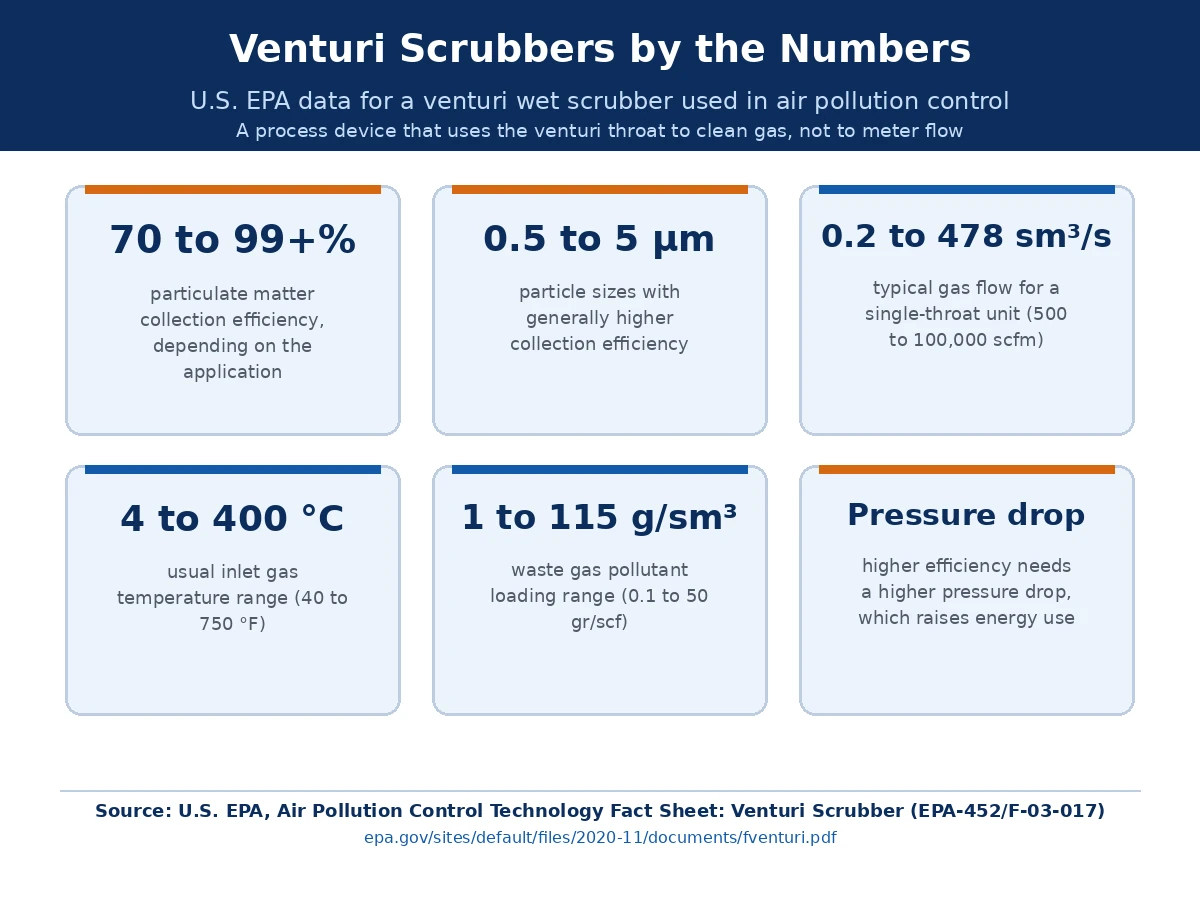
A Venturi scrubber accelerates a dirty gas stream through a throat so scrubbing liquid breaks into fine droplets that capture particles. According to the EPA, collection efficiencies range from 70 to more than 99 percent, depending on the application, and efficiency is generally higher for particles of about 0.5 to 5 micrometers. Typical single-throat units handle 0.2 to 478 standard cubic meters per second, with inlet gas temperatures usually between 4 and 400 degrees Celsius. The EPA lists applications on boilers fired with coal, oil, and wood, and in the chemical, pulp and paper, asphalt, aluminum, and iron and steel industries.
Source: U.S. EPA, Air Pollution Control Technology Fact Sheet: Venturi Scrubber (EPA-452/F-03-017)
The tradeoff is energy. Raising the efficiency of a scrubber requires a higher pressure drop, which increases power consumption, so designers balance capture against fan load.
Medical Oxygen Masks
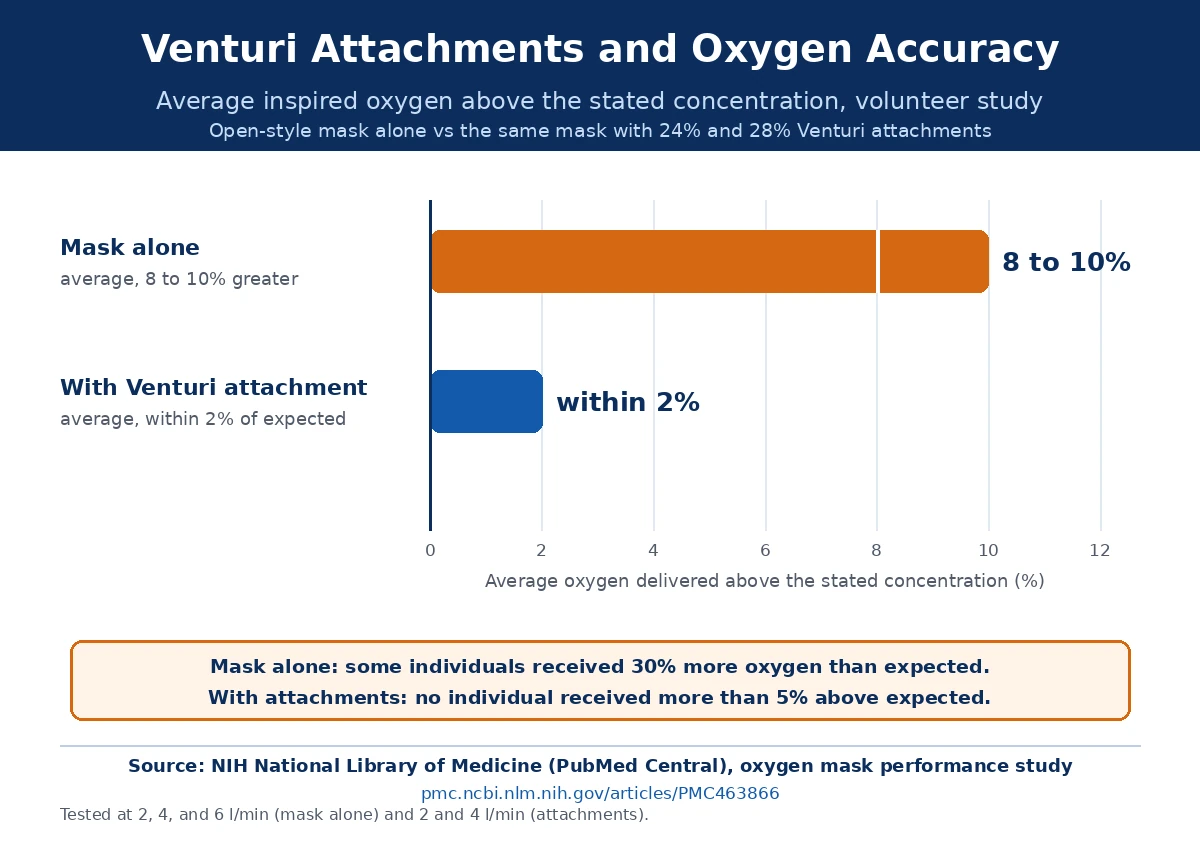
A Venturi mask routes oxygen through a small jet that pulls room air in through side ports, producing a set oxygen concentration. In one study hosted by the National Library of Medicine, interchangeable 24 and 28 percent Venturi attachments delivered average concentrations within 2 percent of the expected values, while the same mask without the attachment delivered 8 to 10 percent more oxygen than stated on its packaging on average. Researchers sometimes describe the air entrainment as jet mixing rather than a strict Venturi effect, but the device is still called a Venturi mask.
Source: NIH National Library of Medicine (PubMed Central), oxygen mask performance study
Automotive Uses
In classic carburetors, a Venturi in the air passage lowers pressure so fuel is drawn into the airflow. Critical-flow Venturis are also used in constant volume sampling systems for vehicle emissions testing, where a fixed flow keeps the sampling steady.
How to Choose a Venturi Tube for Your Application
Matching the Venturi to the job comes down to a few questions, answered in this order.
- Fluid and phase: liquid, gas, or steam, and whether the flow is single-phase
- Line size and expected flow range
- Accuracy target and how much permanent pressure loss the process can tolerate
- Materials suited to corrosion, abrasion, temperature, and pressure
- Upstream piping: straight run or matched meter tubes so the meter sees a stable flow profile
- Verification: a plan for flow meter accuracy and calibration over the life of the installation
For installations that tie several instruments together, complete flow measurement systems keep the primary element, transmitter, and piping working as one design.
Venturi Tubes From Flowell
Flowell Corporation is a family-owned manufacturer of custom machined parts and flow measurement products for the oil and gas industry, with three decades of experience behind every order. Venturi tubes are built to the specification you provide and inspected before they ship.
If you are weighing a Venturi for a new line or replacing an aging meter, tell the team about your line and flow range. The team will help you match the geometry, materials, and connections to the application.
| Request a Quote for Venturi Tubes |
Frequently Asked Questions About Venturi Tubes
What are the most common applications of Venturi tubes?
The most common Venturi tube applications are pipeline flow measurement in oil and gas, water and wastewater treatment, chemical processing, power generation, and irrigation. Venturi principles are also used in scrubbers, medical oxygen masks, and injectors.
Why are Venturi tubes used in oil and gas?
Venturi tubes provide accurate differential pressure flow measurement with low permanent pressure loss and no small openings that clog easily. They are standardized under ISO 5167-4 for full, single-phase, subsonic flow in a pipe.
Are Venturi tubes used in water treatment?
Yes. Venturi meters are a well-established way to measure flow in closed pipes, including water delivery and treatment lines, because they combine high accuracy with comparatively small head loss.
What is a Venturi scrubber used for?
A Venturi scrubber is an air pollution control device that uses a venturi throat to mix gas with scrubbing liquid and remove particulate matter. The EPA reports collection efficiencies from 70 to more than 99 percent, depending on the application.
How is a Venturi used in a medical oxygen mask?
A Venturi mask passes oxygen through a small jet that entrains room air to deliver a set oxygen concentration. In one NIH-hosted study, 24 and 28 percent Venturi attachments delivered average concentrations within 2 percent of the expected values.
Can a Venturi tube be used for irrigation?
Yes. The U.S. Bureau of Reclamation documents low-cost Venturi meters built from PVC fittings with an expected accuracy of about plus or minus 2 percent, used at farm turnouts and for field runoff.
What is the difference between a Venturi tube and a Venturi scrubber?
A Venturi tube is a measurement device that relates a pressure drop to flow rate. A Venturi scrubber uses a similar throat to accelerate gas and atomize liquid so particles are captured. They share the geometry but have different jobs.
How do I choose a Venturi tube for my application?
Start with the fluid, line size, flow range, accuracy target, and allowable pressure loss. Then confirm the material, the straight pipe or flow conditioning available upstream, and how the meter will be calibrated and verified over time.