Pitot Tube vs Venturi Meter: What Is the Difference?

The pitot tube vs venturi meter question comes down to what you need to know about the flow. A pitot tube reads the velocity at a single point in the stream, while a Venturi meter measures the flow rate of everything passing through the pipe. Both rely on Bernoulli’s principle, yet they sense pressure in different ways, suit different jobs, and fail in different ways.
For fixed pipeline measurement in oil and gas, water treatment, and chemical processing, operators lean on Venturi tubes because they combine high accuracy with low head loss. For airspeed, wind tunnels, and quick duct checks, the pitot tube is the familiar tool. The sections below break down how each one works so you can match the device to the measurement.
Pitot Tube vs Venturi Meter at a Glance
| Feature | Pitot tube | Venturi meter |
|---|---|---|
| What it measures | Local velocity at the probe tip, found from total pressure minus static pressure | Flow rate through the full pipe, found from the pressure drop between the inlet and the throat |
| How it senses pressure | Total (stagnation) pressure at the open tip against static pressure at side ports | Static pressure at the inlet against static pressure at the narrowed throat |
| Installation | Slender probe inserted into the stream and aligned with the flow | Flanged section installed in the pipeline |
| Head loss | Very little disturbance to the flow | Low head loss, because the diverging cone recovers pressure |
| Accuracy | Depends on probe alignment, the single measurement point, and clean openings | Commercial units claim plus or minus 0.5 percent primary device accuracy |
| Weak spots | Small differential at low velocity, clogging, and icing | Higher cost and a longer, larger body |
| Typical use | Aircraft airspeed, wind tunnels, duct airflow, and spot checks | Permanent pipeline metering in oil and gas, water treatment, and chemical processing |
What Is a Pitot Tube and How Does It Work?
A pitot tube is a slender probe pointed into the flow. Its open tip captures the total pressure, which includes both the random and the ordered motion of the fluid. Ports on the side of the probe sense static pressure, and the difference between the two is the dynamic pressure. When the two functions are combined in a single probe, it is called a pitot-static tube or a Prandtl tube. On aircraft the tube is around 10 inches long with a diameter of about half an inch.
The Pitot Tube Equation
NASA expresses the relationship as static pressure plus one half the density times the velocity squared equals total pressure. Solving for velocity gives the working equation:
V = √( 2 × (pt − ps) ÷ ρ )
Here pt is total pressure, ps is static pressure, and ρ is the fluid density. Because the equation needs density, the reading is only as good as the pressure and temperature data behind it, and units must be handled carefully.
Pitot Tube Parts and Design
- Impact opening that faces upstream and captures total pressure
- Static ports on the side of the probe that sense static pressure
- A pressure transducer or differential pressure transmitter that compares the two readings
Where Pitot Tubes Are Used
Pitot tubes work as aircraft speedometers and are mounted in wind tunnels to measure airspeed. They also turn up in HVAC duct monitoring and in industrial settings where a quick, straightforward velocity reading is enough. Because the probe reads one point, it is best suited to spot checks and exploratory measurements rather than permanent metering.
Limits of a Pitot Tube
NASA identifies three practical limits. At low velocity the pressure difference is so small that instrument errors can be larger than the measurement. At very high, supersonic speeds, a shock wave at the front of the tube changes the total pressure, so corrections are required. And if the tubes become clogged or pinched, the pressures at the transducer no longer reflect the external flow, which is why airliner probes carry heaters to prevent icing.

Source: NASA Glenn Research Center, Pitot-Static Tube (equation and limitations)
What Is a Venturi Meter and How Does It Work?
A Venturi meter is a section of pipe that squeezes the flow through a smooth, narrow throat and then widens again. As the fluid speeds up in the throat, its static pressure drops, and the pressure difference between the inlet and the throat reveals the flow rate. It is one of the oldest and most dependable differential pressure flow measurement devices, and unlike a probe, it measures the entire flow stream.
Venturi Tube Design
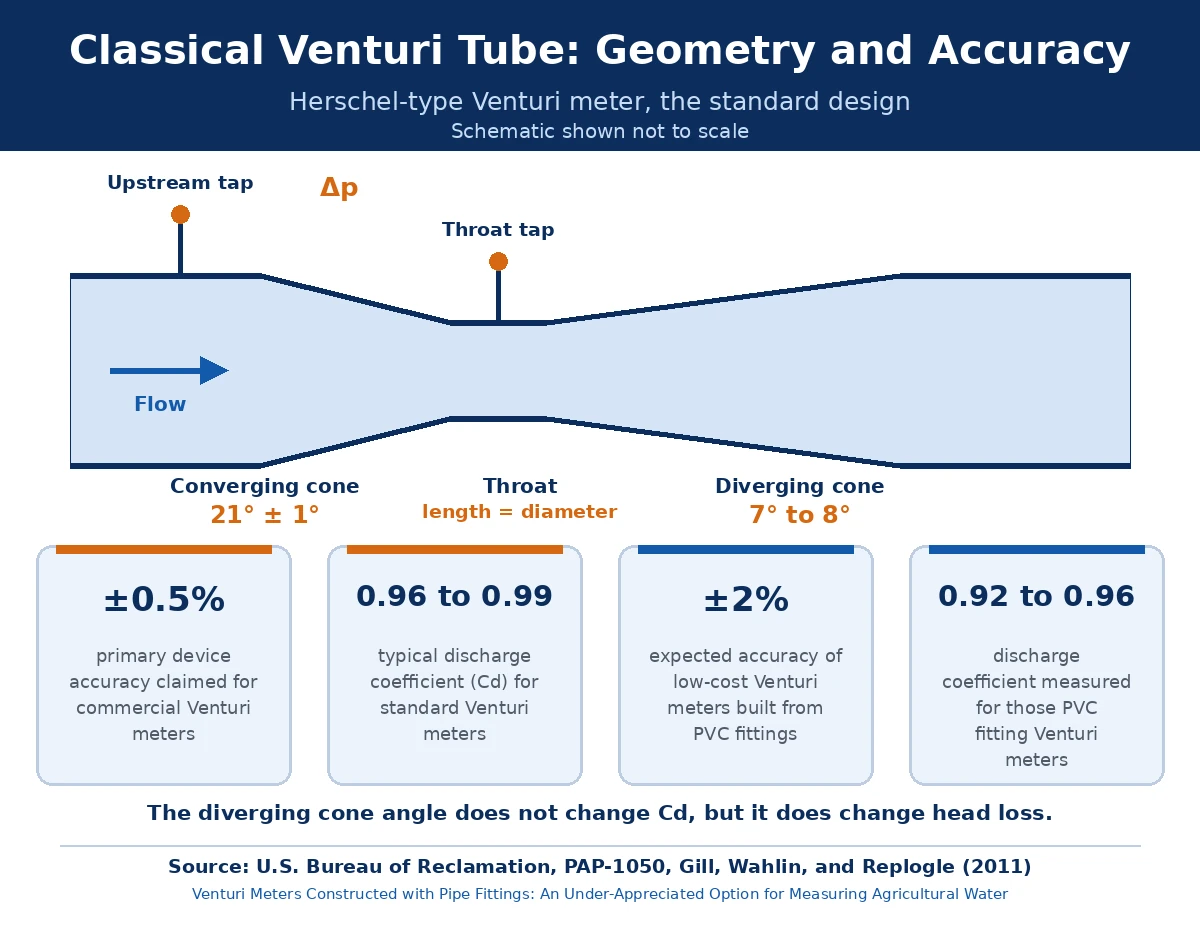
The most common design is the Herschel-type or classical Venturi tube. According to the U.S. Bureau of Reclamation, it has three parts:
- A converging cone of 21 degrees, plus or minus 1 degree, that accelerates the fluid
- A cylindrical throat whose length equals its diameter, where velocity peaks and pressure is lowest
- A diverging cone of 7 to 8 degrees that slows the fluid and recovers most of the pressure
ISO 5167-4:2022 covers the three classical types: as cast, machined, and fabricated. It applies where the flow stays subsonic and the fluid is single-phase, and it does not cover pulsating flow. Within specified limits of pipe size, roughness, diameter ratio, and Reynolds number, a tube can be used uncalibrated, or it can be calibrated across its working range.
The Venturi Tube Equation
For a liquid, the flow rate follows from the throat area, the pressure difference, and a discharge coefficient that accounts for small real-world losses:
Q = ( C ÷ √(1 − β⁴) ) × ( π ÷ 4 ) × d² × √( 2Δp ÷ ρ )
In this form C is the discharge coefficient, d is the throat diameter, β is the ratio of throat to pipe diameter, Δp is the differential pressure, and ρ is the fluid density. For standard Venturi meters the discharge coefficient is typically between 0.96 and 0.99.
Strengths and Trade-Offs of a Venturi Meter
The Bureau of Reclamation describes true Venturi meters as having no stagnant zones, a tolerance for upstream conditions, lower head loss, and fewer fouling problems than most other meters, and it notes they are more accurate than most others. The trade-off is cost and size: a machined, full-length Venturi is a larger and more expensive piece of hardware than a probe.
- Accuracy: commercial Venturi meters claim plus or minus 0.5 percent primary device accuracy
- Low head loss: the diverging cone recovers pressure, and the cone angle affects head loss without changing the discharge coefficient
- Reliability: no moving parts and no stagnant zones where debris collects
- Cost and size: higher purchase price and a longer body than a probe
Key Differences Between a Pitot Tube and a Venturi Meter
Pitot Tube vs Venturi Meter: Which Gives Better Accuracy?
For continuous measurement, the Venturi meter has the edge. It senses the whole stream and works from a defined geometry, while a pitot tube reports velocity at one location and depends on being aligned with the flow and kept clear of debris. A good reading from a pitot tube also depends on a settled flow profile, and straightening vanes upstream of the measurement point help condition the stream so either device sees a stable profile.
Pitot Tube vs Venturi Meter for Pipeline Measurement
In a pipeline that has to run for years, a permanently installed Venturi is the more practical choice. It avoids small openings that can clog, it recovers most of its differential pressure, and it can be paired with a transmitter and a flow computer for continuous readings. Complete Venturi flow meter systems are built around that approach for oil and gas, water treatment, and chemical processing lines.
Cost, Size, and Maintenance
- A pitot tube is simple, compact, and inexpensive, and it can be inserted or removed without major piping changes
- A pitot tube needs regular checks for blockage, icing, and alignment
- A Venturi meter costs more up front and takes more space, but it needs little maintenance once it is installed correctly
- Both devices read best with a settled flow profile, which matched meter tubes help provide
- For long service in a fixed location, the Venturi meter often becomes the more economical option
How to Choose Between a Pitot Tube and a Venturi Meter
Start with the question you need answered. If you need the velocity at a point, such as airspeed or duct velocity, a pitot tube fits. If you need a continuous, accurate flow rate through a pipe, a Venturi meter fits. Then work through the practical factors below.
- Measurement goal: point velocity for a pitot tube, total flow for a Venturi meter
- Accuracy requirement: choose a Venturi meter when you need tight, repeatable results
- Flow range: avoid a pitot tube where velocities are very low, because the signal becomes small
- Fluid cleanliness: avoid small probe openings in dirty or icing conditions
- Permanent or temporary: pitot tubes suit spot checks, Venturi meters suit permanent installs
- Head loss budget: choose a Venturi when pumping energy and downstream pressure matter
After the device is chosen, keeping it accurate over time matters just as much, and good flow meter accuracy and calibration practices keep the readings trustworthy for the life of the installation.
If your pipe size, throat ratio, or alloy falls outside standard designs, custom machining lets the Venturi be built around your line instead of forcing a standard part to fit.
Venturi Tubes and Flow Measurement Hardware From Flowell
Flowell Corporation is a family-owned manufacturer of custom machined parts and flow measurement products for the oil and gas industry, with three decades of experience behind every order. Venturi tubes are built to the specification you provide and inspected before they ship.
Share your line size, fluid, and flow range, and talk with the team about your measurement point. The team will help you decide whether a Venturi meter is the right fit and which configuration will serve the line best.
| Request a Quote for Venturi Tubes |
Frequently Asked Questions About Pitot Tubes and Venturi Meters
What is the difference between a pitot tube and a Venturi meter?
A pitot tube senses total pressure at one point and combines it with static pressure to find the local velocity of the fluid. A Venturi meter measures the pressure drop between a pipe inlet and a narrowed throat to find the flow rate through the whole pipe.
Which is more accurate, a pitot tube or a Venturi meter?
For continuous, full-pipe flow measurement, a Venturi meter is generally the more accurate choice. Commercial Venturi meters claim a primary device accuracy of plus or minus 0.5 percent, while a pitot tube reads the velocity at a single point and is sensitive to alignment and clogging.
What does a pitot tube measure?
A pitot tube measures the stagnation or total pressure at the tip of the probe. With a static pressure reading, the difference is the dynamic pressure, and velocity follows from the square root of twice that pressure divided by the fluid density.
Does a pitot tube measure flow rate?
Not directly. It gives velocity at the probe location. To find a flow rate in a pipe, you need the velocity profile across the pipe and the pipe area, which is why a pitot tube is often used for spot checks while a Venturi meter is installed for continuous metering.
Why does a Venturi meter have low pressure loss?
The diverging cone downstream of the throat slows the fluid gradually and recovers most of the pressure. The angle of that cone does not change the discharge coefficient, but it does change the overall head loss.
What are the limits of a pitot tube?
NASA lists three practical limits. At low velocity the pressure difference is very small and hard to measure. At supersonic speed a shock wave changes the total pressure. If the tubes clog or ice over, the readings no longer reflect the real flow.
What is the discharge coefficient of a Venturi tube?
For standard Venturi meters, the discharge coefficient is typically between 0.96 and 0.99, according to the U.S. Bureau of Reclamation. The exact value depends on the construction and the Reynolds number.
What standard covers Venturi tubes?
ISO 5167-4 covers classical Venturi tubes. It applies where the flow stays subsonic and the fluid is single-phase, and it does not cover pulsating flow.