Permanent Pressure Loss in Flow Measurement: What It Costs
Every differential pressure meter earns its signal by squeezing the flow, and the squeeze has a price. That price is permanent pressure loss, the pressure a flow element removes and never gives back. On a high-volume line it shows up every hour as extra pump or compressor load, so the element you specify decides part of your energy bill for decades.
What Is Permanent Pressure Loss in Flow Measurement?
Permanent pressure loss is the portion of a flow element’s differential pressure that the fluid never regains downstream, so pumps or compressors must keep paying for it. It is the operating cost of creating the measurement signal, and it varies widely by element type and beta ratio.
As fluid accelerates through a restriction, static pressure converts to velocity. Downstream, the stream slows and part of that velocity converts back to pressure. Friction and turbulent eddies consume the rest as heat. What fails to recover is the permanent loss, and it is measured in psi, kPa, or as a percentage of the differential pressure.
Differential Pressure vs Permanent Pressure Loss
Differential pressure is the temporary drop between the upstream tap and the low-pressure tap, and it is what the transmitter reads. Permanent pressure loss is the smaller, lasting drop between the upstream pipe and the point where pressure has fully recovered downstream. One is the signal, the other is the cost.
| Property | Differential pressure | Permanent pressure loss |
|---|---|---|
| What it is | Temporary drop used as the flow signal | Unrecovered drop after downstream recovery |
| Where it is measured | Upstream tap to throat or downstream tap | Upstream pipe to the fully recovered downstream pipe |
| Who uses it | The DP transmitter and flow computer | The pump, compressor, or process engineer |
| What it costs | Nothing once recovered | Continuous energy, every operating hour |
| Main driver | Flow rate and beta ratio | Element geometry and beta ratio |
Why the Vena Contracta Matters
The vena contracta is the point just past the restriction where the jet is narrowest and static pressure is lowest. Taps placed there read the largest differential. Pressure then climbs as the jet expands to fill the pipe, and how completely it climbs is the pressure recovery that sets the permanent loss.
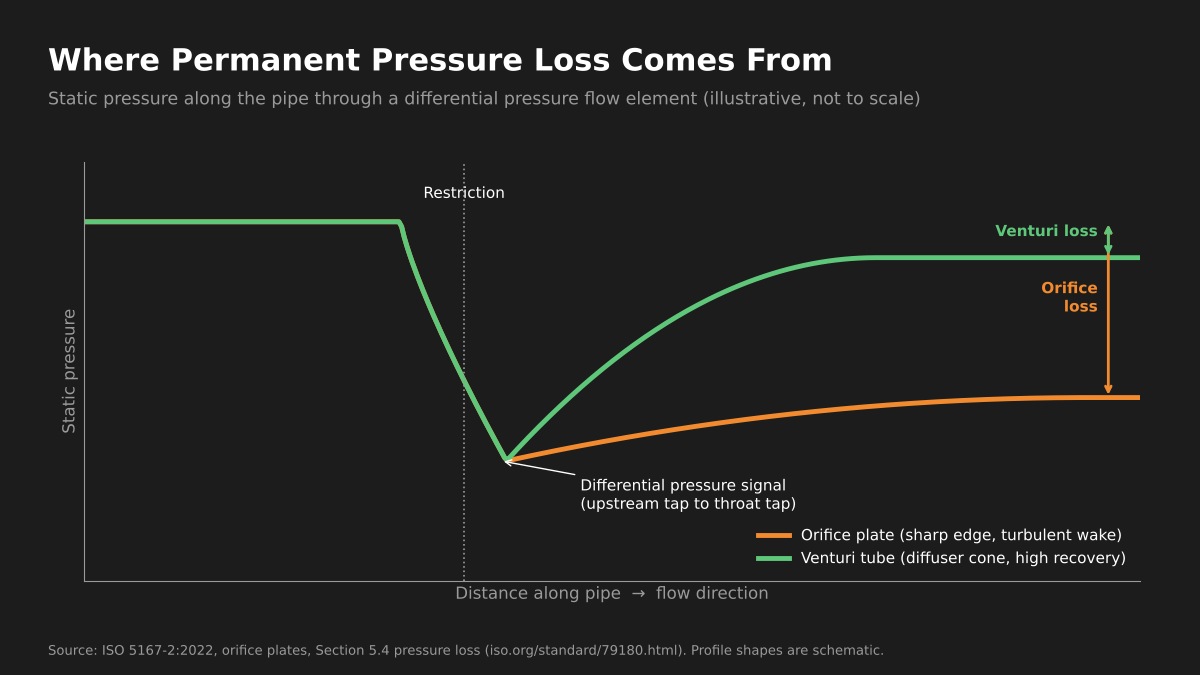
Source: AVEVA instrumentation documentation (ISO 5167 loss method)
Permanent Pressure Loss by Primary Element
Geometry decides how much pressure comes back. A sharp edge separates the flow and builds a turbulent wake, a rounded nozzle inlet separates less, and a Venturi diffuser cone keeps the flow attached to the wall while it slows. The table shows typical results.
| Primary element | Permanent loss (% of differential) | Recovery mechanism | Relative cost |
|---|---|---|---|
| Square-edge orifice plate | About 50% to 90%, depending on beta | None, abrupt restriction and wake | Lowest |
| Flow nozzle | About 35% to 85%, depending on beta | Rounded inlet, no recovery cone | Moderate |
| Venturi tube | 5% to 20% | Diverging recovery cone | Highest |

Orifice Plates: Lowest Cost, Highest Loss
An orifice plate gives the highest permanent pressure loss of the standard elements because the flow separates at the sharp bore edge and never reattaches cleanly. The plate is cheap, easy to swap, and well understood, which is why square-edge orifice plates remain the default on many lines. The cost shows up later in the power bill, so they suit low-flow or intermittent service best. For installation, orifice flange unions make plate inspection and replacement quick.
Flow Nozzles: The Middle Path
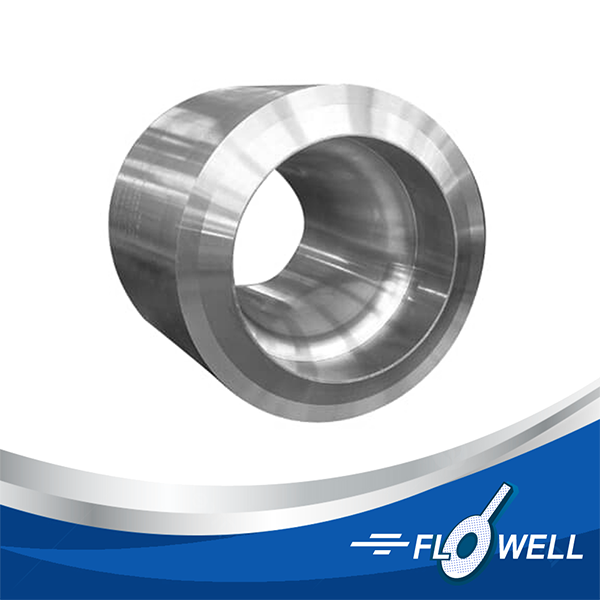
A flow nozzle guides fluid through a curved inlet into a short throat, which cuts inlet turbulence and loses less than an orifice plate at the same beta. It also resists erosion, so the bore keeps its shape in high-velocity steam. Flowell machines custom CNC flow nozzles to hold tight tolerances, and they fit where a full Venturi will not.
Venturi Tubes: Lowest Permanent Loss
A Venturi recovers most of its differential because the diffuser cone slows the fluid gradually and prevents separation. ISO 5167 gives its loss as 5% to 20% of the measured differential, with 15% a sound design estimate. machined Venturi flow elements cost more upfront and need more pipe length, but on large, continuous lines the energy saved usually repays the premium. Flowell also builds complete Venturi meter systems with the meter tube included.

How to Calculate Permanent Pressure Loss for an Orifice Plate
ISO 5167-2 gives the loss as a fraction of the measured differential: loss = [√(1 − β⁴(1 − C²)) − Cβ²] ÷ [√(1 − β⁴(1 − C²)) + Cβ²] × Δp, where β is the beta ratio, C is the discharge coefficient, and Δp is the differential pressure. The method appears in section 5.4 of ISO 5167-2:2022. Orifice plates and nozzles both use this relationship, while Venturi tubes use the 5% to 20% band.
How Beta Ratio Sets Permanent Pressure Loss
Beta ratio, the bore diameter divided by the pipe diameter, is the strongest design lever on loss. A small beta forces a tight restriction, which strengthens the signal and raises the loss. A large beta relaxes the restriction, which saves energy and weakens the signal.
| Beta ratio | Orifice plate loss (C about 0.60) | Flow nozzle loss (C about 0.99) | Signal strength |
|---|---|---|---|
| 0.30 | About 90% | About 84% | Very strong |
| 0.40 | About 82% | About 73% | Strong |
| 0.50 | About 73% | About 60% | Moderate |
| 0.60 | About 63% | About 47% | Lower |
| 0.70 | About 52% | About 35% | Weak at turndown |
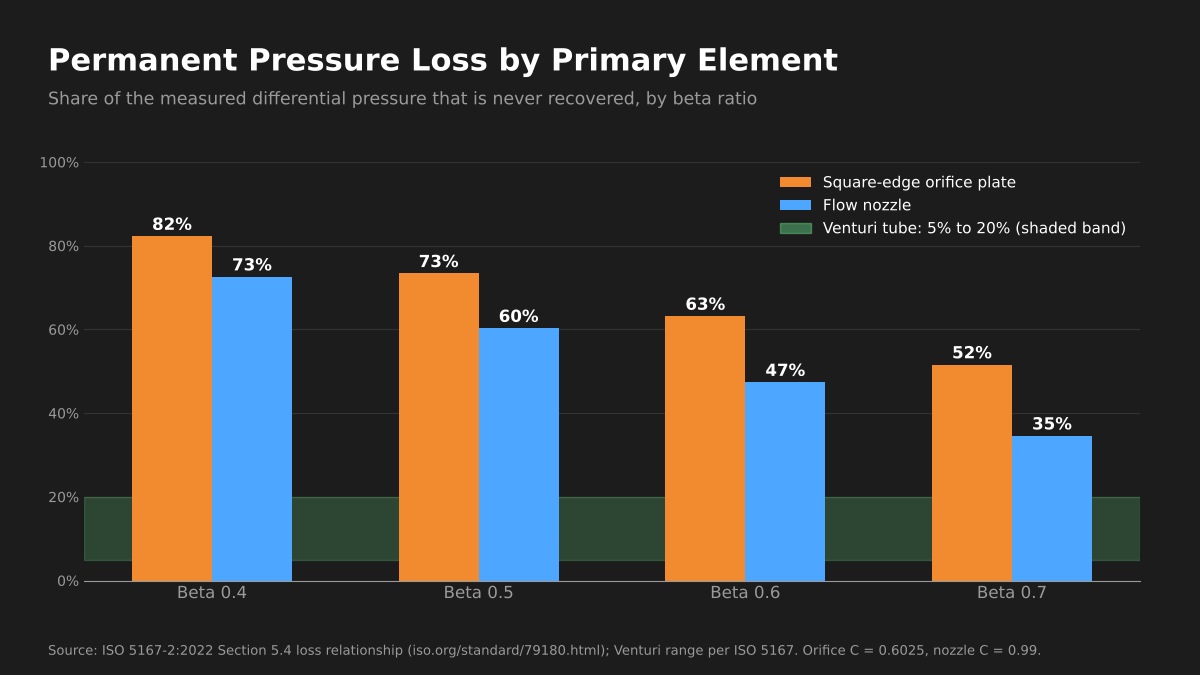
Source: ISO 5167-2:2022 loss relationship
There is no single best beta. Pick the largest beta that still gives the transmitter a usable signal at minimum flow, then verify the straight run. Poor upstream conditions inflate uncertainty regardless of beta, so pair the element with custom meter tubes and straightening vanes where space is tight.
What Permanent Pressure Loss Costs Per Year
Permanent pressure loss converts to electricity through pump power: hydraulic horsepower equals flow in gpm times pressure in psi, divided by 1,714, then divided by pump and motor efficiency. Because the loss repeats every hour, a few psi on a continuous line becomes a recurring utility expense.
Worked Example: A 1,000 gpm Water Line
Take a 1,000 gpm line with a 200 inH2O differential at beta 0.5, 70% wire-to-water efficiency, 8,760 operating hours, and power at 8.5 cents per kWh, close to recent U.S. industrial averages. The Venturi uses the 15% design estimate.
| Primary element | Permanent loss | Annual energy | Annual power cost |
|---|---|---|---|
| Orifice plate | 5.3 psi | 28,856 kWh | $2,453 |
| Flow nozzle | 4.4 psi | 23,722 kWh | $2,016 |
| Venturi tube | 1.1 psi | 5,901 kWh | $502 |
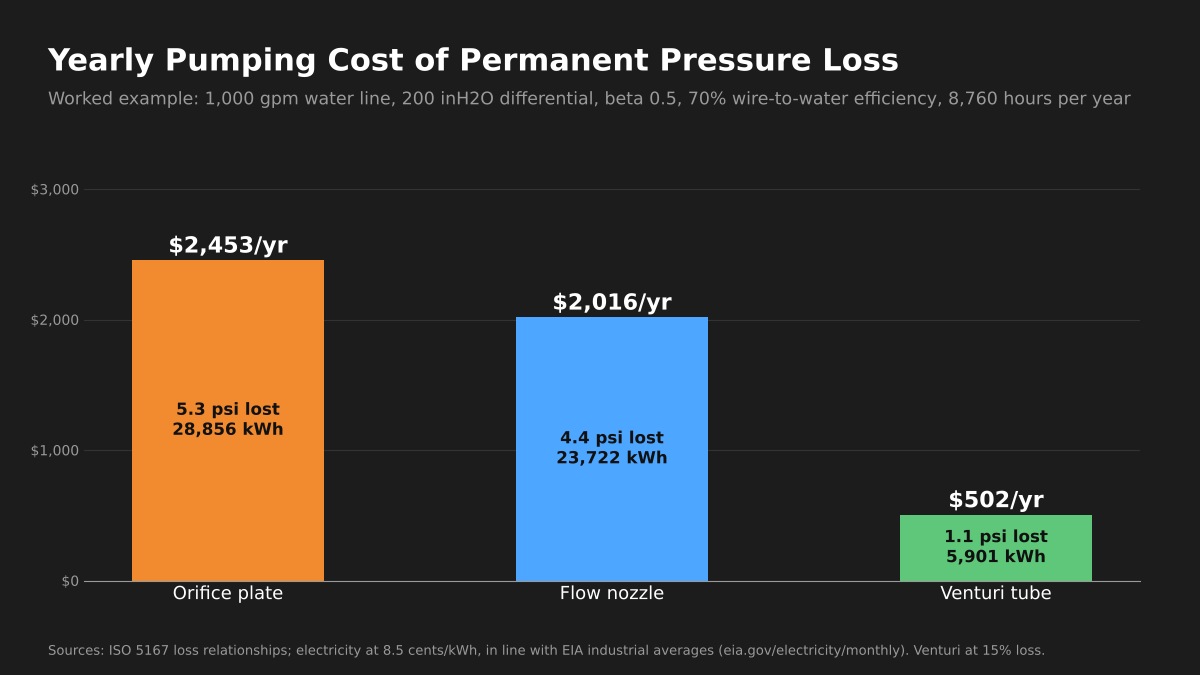
Source: U.S. Energy Information Administration, Electric Power Monthly
Switching that one line from an orifice plate to a Venturi saves about $1,950 a year in this example. Larger lines, higher pump power, or costlier electricity push the figure higher. Pumping systems account for nearly 20% of the world’s motor energy use, according to the U.S. Department of Energy, so small losses repeated across a plant are worth auditing.
How to Estimate Your Own Annual Cost
- Record the differential pressure at normal operating flow from the transmitter range or the sizing sheet.
- Multiply it by the loss percentage for your element and beta ratio (table above), which gives permanent pressure loss in psi.
- Convert to hydraulic horsepower: gpm times psi, divided by 1,714.
- Divide by pump and motor efficiency, then multiply by 0.7457 to get kilowatts.
- Multiply by annual operating hours and your electricity rate, then compare elements.
Signs of Excessive Permanent Pressure Loss
Excess loss shows up as symptoms in the pumps and downstream equipment before it shows up on the meter. Check these indicators during a system audit:
- Pumps or compressors running near maximum capacity without a rise in demand.
- Downstream pressure that falls short of equipment requirements.
- Rising power or fuel use on a line with steady throughput.
- Orifice plates installed at low beta on large, continuous headers.
A static pressure survey at several points along the line isolates which element removes the most. Verified flow meter accuracy and calibration support confirms that any change keeps the meter within tolerance.
How to Reduce Permanent Pressure Loss
You can reduce permanent pressure loss four ways, and they often combine:
- Raise the beta ratio where the transmitter still resolves minimum flow.
- Replace an orifice plate with a flow nozzle where a Venturi will not fit.
- Replace it with a Venturi tube on large, continuous, high-energy lines.
- Fix the upstream profile with a correct meter tube and flow conditioner, so a larger beta stays accurate.
When an Orifice Plate Is Still the Right Choice
An orifice plate still wins on small lines, intermittent service, and tight budgets, where the energy penalty is modest and plate changes must be fast. Compare total cost over the service life rather than purchase price alone.
Orifice Plate vs Flow Nozzle vs Venturi: Which Fits Your Line
| Factor | Orifice plate | Flow nozzle | Venturi tube |
|---|---|---|---|
| Permanent loss | Highest | Intermediate | Lowest |
| Upfront cost | Lowest | Moderate | Highest |
| Installed length | Shortest | Short | Longest |
| Erosion and wear | Edge wears and drifts | Holds shape in steam | Stable, no sharp edge |
| Best fit | Low flow, tight budget | Steam, space limits | Large continuous lines |
Most buyers settle the choice on three numbers: allowable pressure loss, available pipe length, and hours of operation per year. Flowell sizes all three elements, so the recommendation follows your conditions rather than a product preference.
Custom Flow Elements From a Tulsa, Oklahoma Manufacturer
Flowell Corporation has machined flow elements in Tulsa, Oklahoma, since 1993, and builds engineered flow measurement packages where the element, meter tube, and conditioning hardware ship as one matched assembly. That removes the dimensional mismatches that degrade repeatability when parts come from different suppliers, and it supports DP flow measurement systems that hold accuracy while controlling energy use. Flowell also handles custom machine work for lines that need a non-standard fit.
To compare permanent pressure loss for your line, contact the Flowell engineering team at (918) 224-6969 with your fluid, flow range, line size, and allowable pressure loss, and receive an application-specific recommendation.
Request a Quote Start a Sizing Request
Permanent Pressure Loss FAQs
What causes permanent pressure loss in a flow meter?
Friction and turbulence cause it. A restriction speeds the fluid up, and downstream eddies turn part of that kinetic energy into heat instead of pressure. Sharp-edged elements such as orifice plates create the largest wake, so they lose the most.
Can permanent pressure loss be eliminated?
No. Every differential pressure meter needs a restriction to create its signal, and any restriction dissipates some energy. You can only choose an element and beta ratio that keep the loss small, such as a Venturi tube at 5% to 20% of the measured differential.
How does beta ratio affect permanent pressure loss?
A smaller beta ratio raises permanent pressure loss. Under the ISO 5167 loss relationship, a square-edge orifice plate loses about 82% of its differential at beta 0.4 and about 52% at beta 0.7. Larger beta means less loss but a weaker signal for the transmitter to resolve.
How much permanent pressure loss does a Venturi tube have?
ISO 5167 puts Venturi permanent loss between 5% and 20% of the measured differential pressure, depending on diffuser angle, beta ratio, and Reynolds number. A conservative design estimate is 15%.
Does permanent pressure loss affect measurement accuracy?
Not directly. The loss is downstream energy that has already left the system, so it does not change the differential pressure reading. It matters indirectly, because chasing a strong signal with a low beta ratio drives the loss up, and edge wear on sharp elements shifts the discharge coefficient over time.
How does viscosity affect permanent pressure loss?
Viscosity acts mostly through Reynolds number. It changes the discharge coefficient, which moves the loss ratio slightly, and it adds friction in the piping itself. Element type and beta ratio remain the dominant drivers of how much differential pressure is lost.
Why choose a flow nozzle over a Venturi tube?
Choose a nozzle when space or budget rules out a Venturi. A Venturi needs a long recovery cone, while a nozzle fits a shorter spool and costs less. At beta 0.5 the ISO relationship gives a nozzle about 60% loss versus about 73% for an orifice plate, and it resists erosion better in steam service.
Who makes custom Venturi tubes and flow nozzles in Tulsa, Oklahoma?
Flowell Corporation machines custom Venturi tubes, flow nozzles, orifice plates, and meter tubes in Tulsa, Oklahoma, and has done so since 1993. Call (918) 224-6969 or send your line conditions through the sizing form for an application-specific recommendation.