Differential Pressure Flow Measurement
Flowell manufactures components used in differential pressure flow measurement systems for gas, liquid, and steam service where repeatability, stability, and long-term performance matter. In a DP installation, a primary element creates a controlled pressure drop and instrumentation converts that differential into a usable flow value. When the primary element, mounting hardware, meter run, and support components are selected correctly, differential pressure measurement remains one of the most dependable and widely used approaches in industrial service.
Because DP measurement depends on more than one piece of hardware, better results usually come from evaluating the full installation rather than focusing only on a transmitter or one component in isolation. Pressure loss, fluid properties, straight-run availability, service conditions, maintenance access, and long-term accuracy expectations all shape the best final configuration. If you already know your service details, you can move directly into sizing support or contact us for a quote.
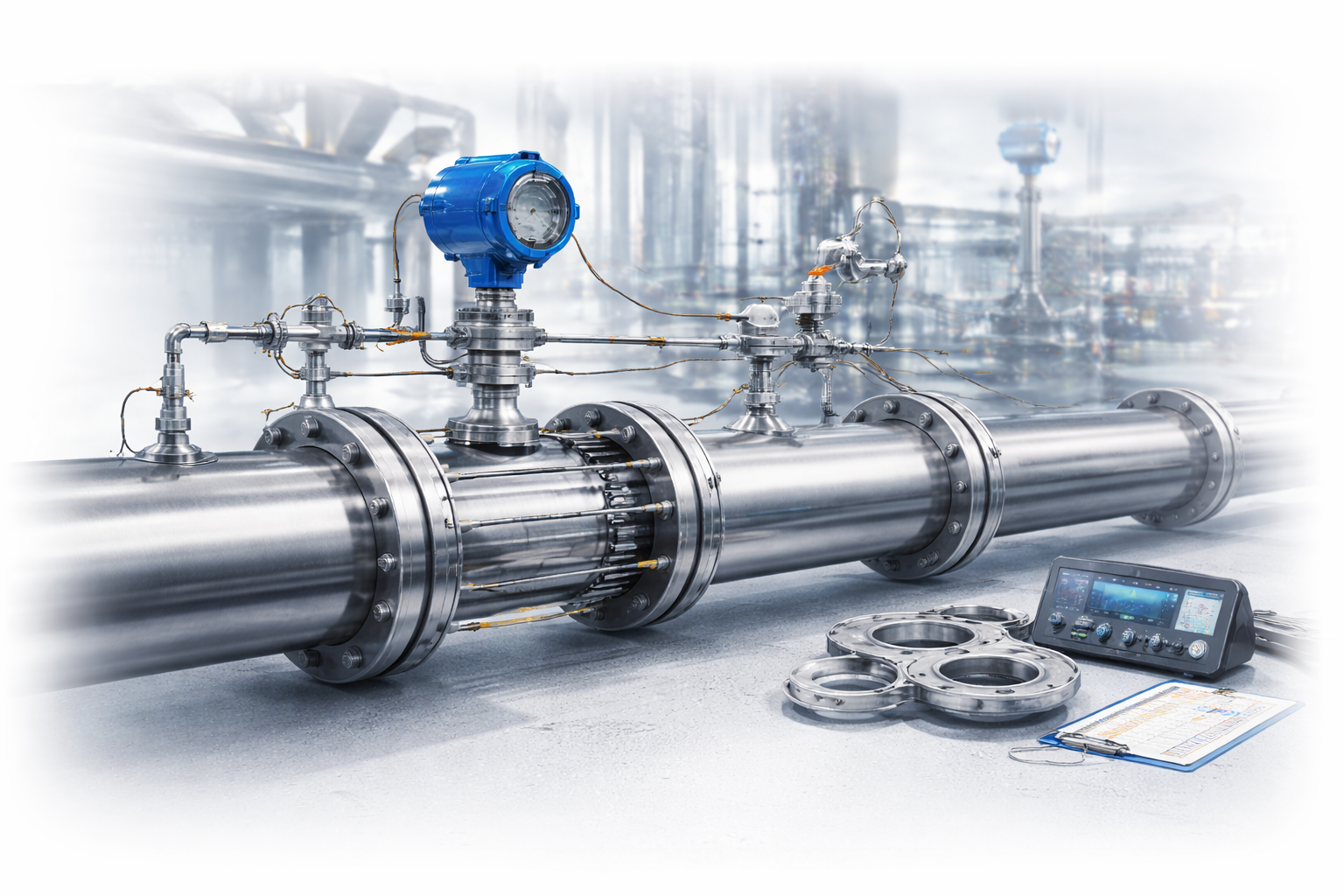
How differential pressure flow measurement works in industrial systems
Differential pressure flow measurement works by creating a predictable restriction in the flow stream and then measuring the pressure difference across that restriction. As velocity changes, the differential pressure changes in a known way, allowing the system to calculate flow rate. This basic concept is simple, but the real performance of a DP system depends on how well the installation supports stable conditions over time.
A successful DP build usually includes a primary element such as an orifice plate, paddle-type orifice plate, venturi, or flow nozzle, along with installation hardware, flow-stabilizing support components, and practical maintenance access. In real plant conditions, swirl, turbulence, debris, or poor fit-up can cause performance drift even when the underlying measurement method is correct.
That is why customers comparing DP options often also review broader flow measurement systems and more specific categories such as orifice plate flow meter systems, venturi flow meter systems, and flow meter accuracy and calibration before finalizing the exact build path.
Good DP performance starts with the full application picture: line size, media, operating pressure and temperature, flow range, allowable pressure loss, straight-run limits, and any known upstream disturbances.
What a complete differential pressure flow measurement system includes
Primary elements
The primary element creates the measurable pressure drop. Common Flowell categories include universal orifice plates, paddle-type orifice plates, venturis, and flow nozzles. Each has different strengths depending on allowable pressure loss, maintenance preferences, and installation conditions.
Installation hardware
Mounting and retention influence alignment, tapping geometry, sealing quality, and long-term serviceability. Depending on the configuration, the build may include an orifice flange union or RTJ plate holders.
Meter run support
Stable flow profile matters. In constrained layouts or systems with upstream disturbance, a meter tube and straightening vanes can help support more consistent results.
Protection and accessories
Debris and contaminated service can affect measurement quality. Flowell also manufactures strainers, bleed rings, and condensate chambers to support reliability and safer maintenance practices.
Choosing the right primary element for differential pressure flow measurement
Differential pressure flow measurement is not one single product decision. It is a system decision. The best primary element depends on the service conditions, pressure drop budget, fluid properties, and how much installation control is available. A lower-cost option may still be the wrong fit if it creates too much permanent pressure loss or if the system cannot maintain stable flow conditions in operation.
How differential pressure flow measurement choices usually break down
| Primary Element | Common Strengths | Typical Fit | Related Flowell Links |
|---|---|---|---|
| Orifice Plates | Standards-based, widely used, practical, cost-effective | General industrial DP service where a proven approach is needed | Universal Orifice Plates and Paddle-Type Orifice Plates |
| Venturis | Lower permanent pressure loss, strong long-term stability | Applications where energy loss matters or stable service is a priority | Venturis |
| Flow Nozzles | Durable geometry, strong fit for higher velocity or severe service | Demanding industrial conditions where nozzle style is preferred | Flow Nozzles |
If your team is weighing the differences between more specific DP configurations, the best next reads are orifice plate flow meter systems and venturi flow meter systems, since those topics go deeper into the installation and performance considerations tied to each method.
Why installation quality matters in differential pressure flow measurement
Many DP systems underperform because the installation never gives the primary element a fair chance to work correctly. Elbows, valves, reducers, upstream turbulence, poor straight run, debris, and inconsistent tap conditions can all change the stability of the measured differential. In practice, those issues often show up as noisy readings, shifting performance, or repeatability problems that look like calibration trouble when the root cause is actually mechanical or hydraulic.
For that reason, Flowell customers often improve results by refining the hardware around the measurement. In some systems, adding a meter tube creates a more dependable flow path. In others, straightening vanes help reduce swirl and profile distortion. In dirty service, strainers may be just as important to long-term reliability as the meter itself.
If you are troubleshooting an unstable installation, it is also worth reviewing what factors affect flow measurement accuracy, how to install a flow meter correctly, and how temperature impacts flow measurement accuracy to isolate what is changing the reading in the field.
Common installation issues that affect DP results
- Insufficient straight run upstream or downstream of the primary element
- Swirl or turbulence from elbows, valves, reducers, pumps, or tight piping layouts
- Improper support hardware, poor fit-up, or unstable tapping geometry
- Debris, fouling, or contamination that changes system behavior over time
- Pressure and temperature changes that were not properly accounted for in the selected configuration
- Mismatch between expected flow range and the actual operating profile
Differential pressure flow measurement performance priorities
Not every customer values the same thing in a DP installation. Some prioritize lower permanent pressure loss. Others care most about practical maintenance, stable long-term repeatability, or a standards-based approach that fits plant familiarity. The chart below shows how these priorities often influence the final direction during early-stage comparison.
Differential pressure flow measurement in gas, liquid, and steam service
DP systems can be used across a wide range of industrial services, but the surrounding support hardware often changes with the medium. Steam applications may need more attention to instrument-side stability and can benefit from condensate chambers. Liquid lines carrying debris may benefit from protective strainers. Gas service with limited straight run may demand more focus on meter run design and profile conditioning.
Flowell products commonly used in differential pressure flow measurement systems
Flowell supports DP flow measurement builds by manufacturing the components that shape repeatability, serviceability, and installation quality. The list below keeps the internal linking more natural and gives each category a clearer role in the system.
Universal Orifice Plates
Precision primary elements used in many standards-based DP applications where broad usability and practical performance are important.
Paddle-Type Orifice Plates
A practical option where handling, accessibility, and maintenance workflow influence the preferred configuration.
Orifice Flange Union
Supports installation geometry and secure integration of an orifice plate assembly within a piping system.
RTJ Plate Holders
Useful where pressure class, retention style, and sealing demands point toward a more robust holder design.
Venturis
Chosen when lower permanent pressure loss and strong long-term measurement stability are major priorities.
Flow Nozzles
Well suited to demanding service and applications where nozzle-style geometry is the stronger engineering fit.
Meter Tubes
Supports a more controlled flow path where straight-run limits or layout issues could otherwise reduce repeatability.
Straightening Vanes
Helps reduce swirl and turbulence so the primary element sees a more stable and repeatable profile.
Bleed Rings
Supports venting and draining between flanges for safer service and more practical system handling.
Condensate Chambers
Useful in steam-related service where the stability of instrument-side conditions matters to the full measurement package.
Strainers
Helps protect the installation from debris-related instability, contamination, and premature component wear.
Custom Machine Work
Supports replacement parts, special materials, modified dimensions, and print-driven requirements tied to real industrial installations.
How to evaluate differential pressure flow measurement before ordering
Early evaluation usually goes faster when the review focuses on the service conditions first and the hardware list second. A good DP recommendation should align with the actual process, not just the nominal line size or a rough memory of the existing system.
Key inputs for sizing and selection
- Line size, schedule, or internal diameter
- Media type and any important composition details
- Operating pressure and temperature range
- Minimum, normal, and maximum flow rate
- Allowable pressure drop and measurement expectations
- Available straight run and known disturbances
- Material requirements and pressure class
Project notes worth sharing up front
- Whether the installation is new, a replacement, or a performance upgrade
- Whether the system has shown drift, instability, or maintenance-related issues
- Whether special materials, print-driven changes, or custom machining are needed
- Whether the service is especially sensitive to debris, pressure loss, or profile disturbance
When customers submit these details through sizing support, the recommendation process usually becomes faster and more accurate than starting with a generic hardware request.
Standards and technical references
Differential pressure devices are commonly discussed within recognized industry standards and accepted installation practices. For a widely recognized reference covering DP flow measurement devices, see ISO 5167. For users comparing practical operating issues, it is also useful to review Flowell resources such as how a differential pressure transmitter is calibrated, flow meter calibration cost, and how often industrial flow meters should be serviced.
Differential Pressure Flow Measurement FAQs
What is differential pressure flow measurement used for?
Differential pressure flow measurement is used to measure the flow of gas, liquid, or steam by creating a controlled pressure drop across a primary element and converting that differential into a flow value. It remains one of the most widely used approaches in industrial service because it is flexible, well understood, and adaptable to many process conditions.
How do I choose between an orifice plate, venturi, and flow nozzle?
The right choice depends on allowable pressure loss, maintenance preferences, service severity, and installation conditions. Orifice plates are common standards-based choices, venturis are often selected when lower permanent pressure loss matters, and flow nozzles are often considered in more demanding service.
Can installation problems affect differential pressure flow measurement accuracy?
Yes. Upstream disturbances, limited straight run, debris, unstable tapping conditions, and poor fit-up can all reduce repeatability or create unstable readings. That is why components such as meter tubes, straightening vanes, and strainers can materially improve the finished system.
Do you help with complete DP system selection and sizing?
Yes. Use sizing support to send your line size, media, pressure, temperature, and expected flow range. Flowell can then recommend a practical DP direction and compatible components based on the service details you provide.
Can Flowell support non-standard or replacement configurations?
Yes. If your project requires replacement hardware, special materials, modified dimensions, or a print-driven part, Flowell also offers custom machine work to help align the finished component with the actual installation.
Talk with Flowell about your DP application
If you are comparing primary elements, replacing legacy hardware, or trying to improve measurement stability, send your application details through our contact page or start with sizing support. You can also return to the homepage or review additional flow measurement products for related categories.