Reynolds Number in Flow Measurement Explained Simply
In industrial systems, the Reynolds number in flow measurement is one of the most important concepts for understanding how fluids behave inside pipes and how accurately flow meters can perform. Whether the fluid is crude oil, natural gas, water, chemicals, or refined petroleum products, the way it moves through a pipe directly affects measurement stability, repeatability, pressure loss, and meter selection. Reynolds number helps engineers and operators determine whether flow is smooth and orderly, unstable and transitional, or highly mixed and turbulent.
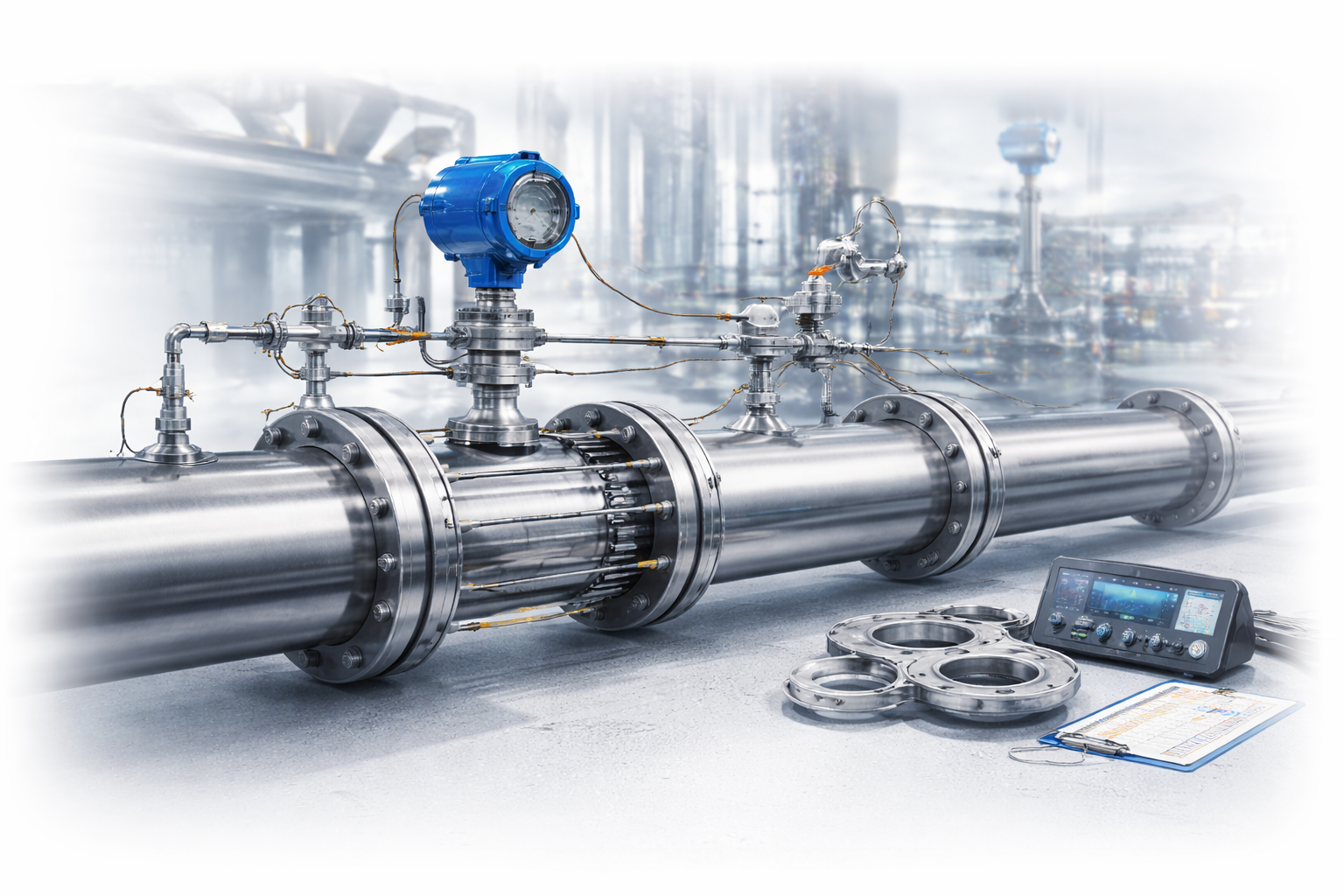
At its core, the Reynolds number is a dimensionless value used to describe the relationship between a fluid’s motion, viscosity, density, velocity, and pipe diameter. Although the formula may look technical, the practical idea is simple: Reynolds number tells you what kind of flow pattern is happening inside the pipe. That flow pattern matters because flow meters do not all respond the same way to different flow conditions.
For oil and gas operations, machining systems, and flow measurement applications, understanding Reynolds number can help improve accuracy, reduce system problems, and support better equipment decisions. A meter that performs well in one flow condition may not be ideal in another. That is why the Reynolds number plays such a key role in flow meter performance and selection.
Reynolds Number in Flow Measurement Explained
Reynolds number is used to predict the flow regime within a pipe or process line. In other words, it helps identify whether fluid flow is laminar, transitional, or turbulent. These terms describe how fluid particles move as they travel through a pipe.
In a smooth, slow-moving fluid, particles tend to move in parallel layers. This is known as laminar flow. In faster-moving conditions, fluid particles mix more aggressively and create swirling patterns. This is known as turbulent flow. Between those two states is transitional flow, where the fluid may shift between smooth and turbulent behavior depending on operating conditions.
Reynolds number is especially useful because it allows different systems to be compared even when their pipe sizes, fluids, or velocities are different. A small pipe carrying a thin liquid at high speed may have turbulent flow. A large pipe carrying a thick fluid at low speed may have laminar flow. The Reynolds number gives operators a common way to evaluate these conditions.
In flow measurement, this matters because meters are calibrated and designed around certain assumptions about the fluid profile. A flow profile is the shape of the velocity distribution across the pipe. In laminar flow, velocity is usually highest near the center of the pipe and much lower near the walls. In turbulent flow, velocity is more evenly distributed, although wall effects still exist. These differences can change how a meter senses and calculates flow.
Flow measurement professionals use the Reynolds number to:
- Identify the expected flow regime
- Evaluate whether a meter is operating within its recommended range
- Understand potential accuracy concerns
- Compare flow behavior across different fluids and pipe sizes
- Support meter sizing and selection
- Diagnose unstable or inconsistent readings
Because the Reynolds number is dimensionless, it does not use units such as feet, gallons, pounds, or seconds in the final value. Instead, it combines several measured properties into one practical indicator of flow behavior.
Reynolds number in flow measurement calculations
The common Reynolds number formula for pipe flow is:
Re = ρVD / μ
In this formula:
- Re is Reynolds number
- ρ is fluid density
- V is average fluid velocity
- D is pipe inside diameter
- μ is dynamic viscosity
Another common form uses kinematic viscosity:
Re = VD / ν
In this version:
- V is average velocity
- D is pipe inside diameter
- ν is kinematic viscosity
Both formulas are used to describe the same physical relationship. The main difference is whether the calculation uses dynamic viscosity and density separately or kinematic viscosity as a combined value.
For practical flow measurement, the calculation helps determine whether the current process conditions fall into one of three general categories:
- Laminar flow: typically below Reynolds number 2,000
- Transitional flow: typically between Reynolds number 2,000 and 4,000
- Turbulent flow: typically above Reynolds number 4,000
These ranges are general guidelines for flow in circular pipes. Real-world applications may vary based on pipe roughness, fittings, valves, flow disturbances, fluid properties, and installation conditions. Still, these values provide a useful starting point for evaluating flow behavior.
A simple way to understand the calculation is to think of the Reynolds number as a comparison between forces that keep fluid moving forward and forces that resist motion. High velocity, larger pipe diameter, and higher density tend to increase the Reynolds number. Higher viscosity tends to decrease it.
This is why heavy oils, viscous chemicals, and slow-moving fluids are more likely to produce laminar flow. Lighter fluids, gases, and higher-velocity applications are more likely to produce turbulent flow.
Laminar vs. Turbulent Flow Conditions
Laminar and turbulent flow conditions behave very differently inside a pipe. These differences can have a direct impact on meter performance, pressure drop, calibration, and measurement reliability.
Laminar flow is smooth and organized. The fluid moves in layers, with little mixing between those layers. The fluid closest to the pipe wall moves slowly due to friction, while the fluid near the center moves faster. This creates a more pronounced velocity profile.
Turbulent flow is mixed and energetic. Fluid particles move in many directions while still progressing down the pipe. This creates eddies, swirls, and fluctuations, but it also produces a flatter velocity profile across much of the pipe. In many flow meter applications, turbulent flow is easier to measure consistently because the velocity profile is more predictable for certain meter technologies.
Transitional flow falls between laminar and turbulent conditions. It can be challenging because the flow pattern may not remain stable. Small changes in velocity, viscosity, temperature, or pressure can shift the flow from one behavior to another. This makes transitional flow one of the more difficult ranges for accurate flow measurement.
Common characteristics of laminar flow include:
- Low Reynolds number
- Smooth fluid motion
- Limited internal mixing
- Strong centerline velocity
- Greater sensitivity to viscosity
- More common with thick fluids or low velocities
Common characteristics of turbulent flow include:
- High Reynolds number
- Strong internal mixing
- Flatter velocity profile
- More stable meter response in many applications
- Greater influence from pipe roughness and upstream disturbances
- More common with gases, water-like liquids, and high flow rates
Both flow types can be measured, but the right meter must be chosen for the application. Problems arise when a meter is used outside of the flow conditions it was designed to handle.
Velocity, viscosity, and pipe diameter effects
Velocity, viscosity, and pipe diameter are three of the most important factors affecting Reynolds number. Each one can change the flow regime and influence how a meter performs.
Velocity has a direct effect. As velocity increases, the Reynolds number increases. This means a slow-moving fluid may remain laminar, while the same fluid at a higher velocity may become turbulent. For many meters, maintaining an adequate velocity range is essential for accurate measurement. If flow is too slow, the meter may lose sensitivity or produce unstable readings.
Viscosity has the opposite effect. As viscosity increases, the Reynolds number decreases. A thick oil or heavy fluid resists internal movement, which makes laminar flow more likely. This is why viscosity compensation is often important in oil and gas applications. Temperature also matters because viscosity often changes as fluid temperature changes. For example, oil may flow more easily when warm and become more resistant when cold.
Pipe diameter also affects the Reynolds number. A larger pipe diameter increases the Reynolds number when other variables remain the same. However, pipe diameter also influences velocity. If the same flow rate moves through a larger pipe, the velocity may decrease. This means pipe sizing and meter sizing must be evaluated together, not separately.
These variables often interact. For example:
- Increasing flow rate usually increases velocity and Reynolds number
- Increasing viscosity usually lowers the Reynolds number
- Increasing pipe diameter can increase Reynolds number, but may reduce velocity for the same flow rate
- Increasing temperature may reduce viscosity for many liquids, which can increase the Reynolds number
- Changing product type can significantly change density and viscosity
Because of these interactions, accurate flow measurement depends on more than simply choosing a meter that fits the pipe. The operating conditions must be considered as a complete system.
Why Reynolds Number Matters for Meter Accuracy
Reynolds number matters because flow meters are affected by how fluid moves through them. A meter does not simply measure fluid volume in isolation. It responds to velocity profile, flow stability, pressure, turbulence, viscosity, and installation conditions. The Reynolds number helps predict these conditions before they create measurement problems.
Different flow meters have different sensitivities to Reynolds number. Some meters perform best in turbulent flow, where the velocity profile is more uniform. Others can handle laminar or viscous conditions if properly selected and calibrated. Some technologies require correction factors when the Reynolds number changes significantly.
When the Reynolds number is not considered, several issues can occur:
- Flow readings may become unstable
- Accuracy may decrease at low flow rates
- Calibration may not match real operating conditions
- Pressure drop may be higher than expected
- Meter repeatability may suffer
- The selected meter may not meet performance requirements
- Custody transfer or process control measurements may become less reliable
For example, differential pressure meters, such as orifice plates, are commonly influenced by Reynolds number because discharge coefficients can change with flow conditions. Turbine meters may require sufficient flow velocity and fluid characteristics to maintain proper rotor response. Positive displacement meters can be effective for viscous fluids, but sizing and pressure drop still matter. Coriolis meters can handle a wide range of fluids, but application details such as density, viscosity, and flow rate still influence performance and suitability.
This is why Reynolds number should be considered during meter selection, system design, and troubleshooting. It helps answer practical questions such as:
- Is the flow likely to be laminar or turbulent?
- Will the meter operate within its recommended Reynolds number range?
- Is the flow rate high enough for stable measurement?
- Will viscosity changes affect accuracy?
- Is the pipe size appropriate for the expected operating range?
- Are upstream and downstream straight-run requirements important?
- Will flow conditioning be needed?
A meter may be high quality, but if it is installed in the wrong flow regime or used outside its operating range, performance can suffer.
Matching meters to flow regimes
Matching meters to flow regimes means selecting a flow measurement technology that is compatible with the expected Reynolds number range and process conditions. This is especially important in oil and gas applications, where fluids can vary widely in viscosity, density, pressure, temperature, and composition.
For low Reynolds number applications, such as viscous oils or slow-moving liquids, meters that can handle laminar flow may be necessary. Positive displacement meters are often considered for viscous fluids because they measure discrete volumes rather than relying only on velocity profile. Coriolis meters may also be used in many applications where mass flow, density, and accuracy are important.
For high Reynolds number applications, such as many gas, water, and light hydrocarbon services, meters designed for turbulent conditions may perform well. These can include turbine meters, ultrasonic meters, vortex meters, differential pressure meters, and other technologies, depending on the specific process requirements.
For transitional flow, careful evaluation is especially important. Since flow can shift between laminar and turbulent behavior, the meter may experience changing accuracy characteristics. In these cases, engineers may need to adjust meter size, increase velocity, choose a different meter technology, or account for changing viscosity and temperature.
Important considerations when matching meters to flow regimes include:
- Fluid type and composition
- Minimum, normal, and maximum flow rates
- Operating temperature and pressure
- Fluid viscosity and density
- Pipe size and schedule
- Required accuracy and repeatability
- Pressure drop limitations
- Installation layout
- Straight-run requirements
- Maintenance access
- Calibration requirements
- Industry standards or custody transfer needs
Meter selection should also account for real operating conditions rather than ideal conditions alone. Flow systems often include elbows, valves, reducers, strainers, pumps, compressors, and other components that can disturb flow before it reaches the meter. These disturbances can affect the flow profile and may require straight pipe runs or flow conditioners to improve measurement performance.
In short, the Reynolds number helps bridge the gap between theory and practical meter performance. It gives engineers and operators a clearer understanding of what is happening inside the pipe and how that behavior may affect measurement accuracy.
FAQ
What is the Reynolds number in simple terms?
The Reynolds number is a value that helps describe how fluid flows through a pipe. It indicates whether the flow is smooth and layered, unstable and transitional, or mixed and turbulent.
Why is the Reynolds number important in flow measurement?
It is important because flow meters respond differently to different flow patterns. Reynolds number helps determine whether a meter is suitable for the flow conditions and whether accuracy may be affected.
What Reynolds number indicates laminar flow?
In circular pipe flow, laminar flow is typically associated with a Reynolds number below about 2,000.
What Reynolds number indicates turbulent flow?
Turbulent flow is typically associated with a Reynolds number above about 4,000 in pipe flow.
What happens in the transitional flow range?
Transitional flow usually occurs between Reynolds number 2,000 and 4,000. In this range, flow may shift between laminar and turbulent behavior, which can make measurement less stable.
How does viscosity affect Reynolds number?
Higher viscosity lowers the Reynolds number. This means thick fluids are more likely to have laminar flow, especially at lower velocities.
How does velocity affect Reynolds number?
Higher velocity increases the Reynolds number. As fluid moves faster, it is more likely to become turbulent.
Does pipe size affect Reynolds number?
Yes. Pipe diameter is part of the Reynolds number calculation. However, pipe size also affects velocity, so it must be evaluated along with flow rate and fluid properties.
Can the wrong flow meter be chosen if the Reynolds number is ignored?
Yes. Ignoring Reynolds number can lead to poor meter performance, unstable readings, reduced accuracy, or a meter that is not suited for the application.
Is turbulent flow always better for flow measurement?
Not always, but many meters perform more consistently in turbulent flow because the velocity profile is often more uniform. Some applications, especially viscous fluid services, may require meters designed for laminar or low Reynolds number conditions.
Partner With Flowell Corporation for Flow Measurement Solutions
When accuracy, reliability, and performance matter, choosing the right flow measurement products and machining partner is essential. Flowell Corporation is your premier destination for custom machining and flow measurement products for the oil and gas industry. Based in Tulsa, OK, we are a trusted name for top-notch services and high-quality products designed to meet demanding machining and flow measurement needs.
With three decades of experience and a team of skilled professionals, we deliver excellence in every aspect of our work. Whether you need custom machining support, flow measurement products, or guidance for oil and gas applications, we have the experience and capability to help you move forward with confidence. Contact us to learn more about dependable solutions built for your operation.